
Archidian vs Nomic: Two Strong Approaches to AI-Powered AEC Review
Nomic and Archidian solve different AEC review challenges. Nomic handles broad document intelligence. Archidian focuses on drawing QA/QC. Which approach fits your team?
Introduction
Nomic recently published a comparison between its platform and Archidian, and we appreciate being included in the conversation about AI in AEC. Nomic is building an impressive AI platform for AEC teams working across large amounts of project information, including drawings, specifications, submittals, RFIs, and code-related documentation.
Both Nomic and Archidian are working toward a similar broader goal: helping AEC professionals automate review processes and catch issues earlier in the project lifecycle. Where the two platforms differ is in their starting point and core workflow. Understanding those differences matters if you're evaluating which approach fits your team's needs.
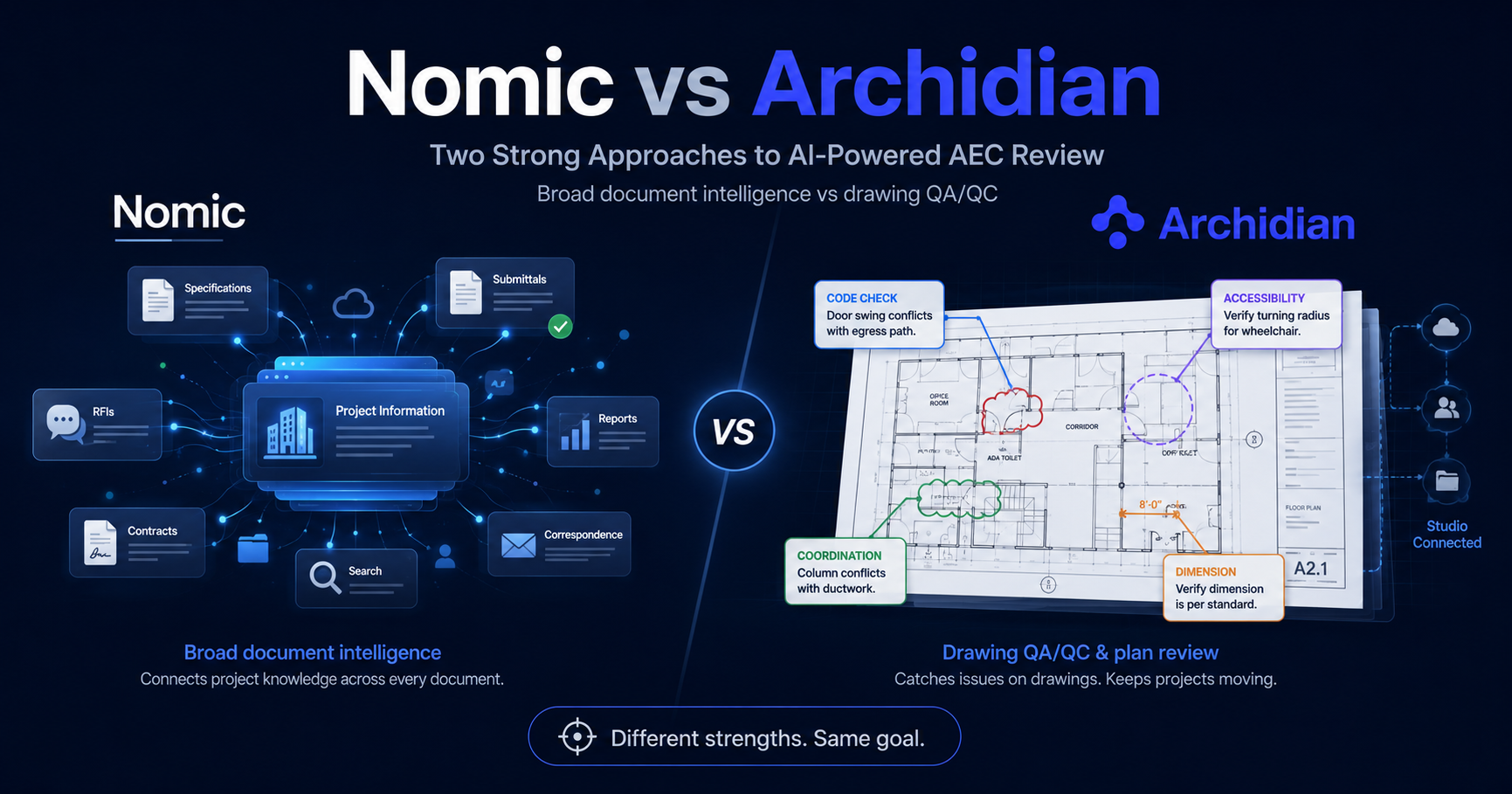
Nomic starts from the whole document environment — specs, submittals, RFIs, and project records — and works inward.
Archidian starts from the construction drawings and the QA/QC that has to hold up across the full set.
Where Nomic Stands Out
Nomic appears to take a broad document intelligence approach to AEC workflows. Its platform is designed to help teams work across multiple document types and project phases, with strengths in specifications, submittals, RFIs, and broad code and standards coverage.
For large firms managing extensive project documentation and building codes, that wider approach can be extremely valuable. Teams do not only need answers from construction drawings. They also need to search, organize, compare, and review information spread across numerous project records. Nomic is addressing that larger document environment in a meaningful way, offering what amounts to a domain-specific AI solution for teams juggling many different document types simultaneously.
Clarifying Archidian's Focus
Nomic's comparison accurately identifies several Archidian capabilities, including plan review, permit intake support, sheet completeness checks, title block review, signature checks, and local code package workflows.
Where we would add clarification is that Archidian is not only a code compliance or permit intake tool. That's an important part of what it does, but it's not the complete picture.
Archidian is built around construction drawing QA/QC as a core workflow. It helps architecture firms, engineering teams, and AEC professionals evaluate drawing sets for code-related concerns, accessibility conditions, life safety issues, coordination gaps, and documentation inconsistencies before those issues become permit comments, RFIs, rework, or construction delays.
The focus is not simply whether a requirement exists in a building code. The focus is whether the drawing set actually communicates, coordinates, and documents that requirement clearly across the full set. That's a meaningful distinction. A drawing may technically comply with code language while still containing coordination problems, sheet index errors, callout inconsistencies, or accessibility oversights that will surface later during permit review or construction.
Drawing Review Inside the Existing Workflow
A key part of Archidian's approach is its live Bluebeam Studio integration. Teams can pull drawings directly from an active Bluebeam Studio Session into Archidian for review through the Archidian website.
That matters because Bluebeam is already central to how many AEC teams mark up drawings, coordinate comments, and manage review discussions. By allowing teams to bring active Studio Session drawings directly into the review process without file transfers or reorganization, Archidian reduces friction in the workflow. Teams review the drawing set they are already coordinating on, rather than creating a separate, disconnected review cycle.
This integration reflects a core belief about how AEC teams actually work: review workflows should fit into existing tools and habits, not require teams to exit their established processes. Archidian's drawing-centered approach is designed to support the way architects and engineers already evaluate documents through PDFs, markups, coordination comments, and active project conversations.
A Simple Comparison
Swipe the table to compare →
| Category | Nomic | Archidian |
|---|---|---|
| Main Focus | Broad AEC document intelligence | Drawing QA/QC and plan review |
| Strongest Use Case | Specs, submittals, RFIs, and project information | Drawing quality, coordination, and compliance review |
| Code Approach | Broad code and standards coverage | Code review tied to drawing conditions |
| QA/QC | Part of a broader platform | Core workflow |
| Accessibility + Life Safety | Compliance capabilities | Core drawing review categories |
| Permit Readiness | Supported workflow | Primary workflow |
| Bluebeam Studio Integration | Not emphasized | Live drawing pull from Studio Sessions |
| Best Fit | Teams seeking broad document intelligence | Teams focused on stronger drawing review outcomes |
Which Platform May Be the Better Fit?
For firms seeking a broad intelligence layer across specifications, submittals, RFIs, and many types of project documentation, Nomic may be an excellent fit. Its approach appears well suited to organizations managing a large and complex document ecosystem where cross-document review and submittal management are critical.
For architecture firms, engineering teams, and AEC professionals focused on improving construction drawing quality, catching coordination issues, reviewing accessibility and life safety conditions, and bringing AI-powered drawing review directly into Bluebeam-based workflows, Archidian may be the more focused fit.
The choice ultimately depends on whether your primary need is broad project intelligence across many document types, or stronger drawing set consistency and QA/QC outcomes before submission and construction.
Final Thoughts
We respect the work Nomic is doing and appreciate the comparison they published. The distinction is not that one product is solving the right problem and the other is not. Nomic and Archidian are solving different parts of a very real challenge in AEC: helping teams review complex information earlier, more consistently, and with better outcomes.
The AEC industry needs both approaches. Teams need broad document intelligence for managing project information at scale. They also need focused drawing review tools that catch coordination gaps, code issues, and accessibility oversights before they become expensive problems. Both address real workflows. Both address real pain points.
If your team is evaluating AI solutions for AEC review, the question is not which platform is objectively better. The question is which one aligns with how your team works and what your most pressing review challenges actually are.